
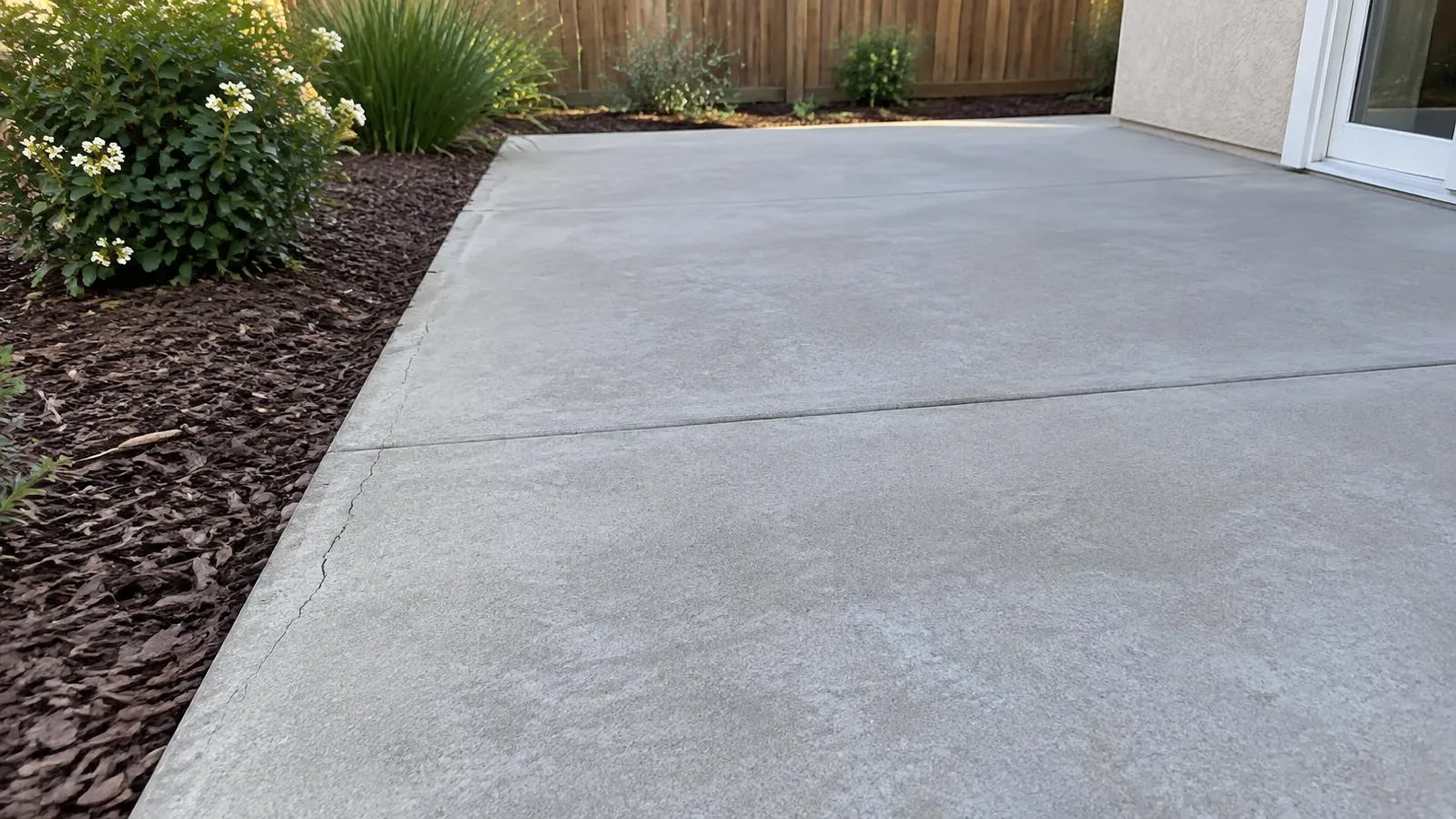
Why Concrete Cracks in Folsom, CA
Most Cracks Follow a Plan, or They Follow NothingConcrete almost always cracks a little as it cures. The question is whether it cracks along a joint we planned, or wherever the slab and the ground under it decide.
We plan every joint before the concrete goes in, not after it cracks.
Why Does Concrete Crack in Folsom Yards?
Concrete cracks mainly because it shrinks as it cures and dries, not because the crew did something wrong. As wet concrete sets, water leaves the mix and the slab pulls in on itself just slightly. That small pull has to go somewhere. A control joint gives it a straight, planned line to follow. Without one, the crack picks its own path, often a crooked one across the middle of the slab.
A second cause sits under the slab. If the base settles, washes out, or was never packed tight, the concrete above it has nothing solid to rest on and cracks follow the dip. Some Folsom lots add a third factor: clay soil that swells when it rains and a claypan layer that holds water close to the surface, which our hardscaping in Folsom page covers in more depth.
Shrinkage Crack or Settlement Crack?
| What you see | Likely cause | What it means |
|---|---|---|
| A thin, straight crack along a tooled line | Normal shrinkage, following the control joint | Expected. Usually just needs sealing. |
| A crack that wanders across the middle of a panel | No joint nearby, or panels spaced too far apart | Points to joint spacing or layout, not the concrete mix. |
| One side of the crack sits higher than the other | The base under the slab settled or washed out | Usually means the slab needs to come out and the base rebuilt. |
| A wide crack that keeps getting wider over seasons | Soil movement under the slab, often swelling clay | Sealing will not stop this. The base needs attention. |
How We Plan Joints on a New Folsom Slab
The National Ready Mixed Concrete Association sets out a simple rule for where joints go. We follow it on every pour:
- Measure the slab thickness. A typical patio runs about 4 inches.
- Space joints at roughly 24 to 36 times that thickness, so about 8 to 10 feet apart on a 4 inch slab.
- Never space joints more than about 15 feet apart, even on a thicker slab.
- Keep each panel close to square. A panel more than about 1.5 times as long as it is wide cracks on its own.
- Cut or tool each joint at least a quarter of the slab's depth, and at least 1 inch deep.
- Avoid L-shaped panels around corners, since the inside corner cracks almost every time.
We size and place joints this way before the concrete is ever poured, using the National Ready Mixed Concrete Association's joint spacing guide as our baseline, then adjust for the shape of your patio or driveway.
Signs the Ground, Not the Concrete, Is the Problem
- A crack that is wider at one end than the other.
- A section of the slab that has dropped or tilted compared to the rest.
- Cracks that showed up within the first year or two, before normal shrinkage would explain them.
- Standing water that collects against one side of the slab after it rains.
- New cracks appearing every winter in roughly the same spot.
Questions to Bring to the Free Visit
- Is this crack following a joint, or cutting across the slab on its own?
- How deep will you dig to check the base under it?
- Will you reuse the existing base, or rebuild it?
- How far apart will the new joints be?
- What is different about my yard's soil that I should know about?
For the rest of our hardscape work in town, see our page on hardscaping in Folsom, CA.
Why Folsom Homeowners Trust McGuire Earth Works
- 4.9 star Google rating
- BBB A+ accredited
- CSLB licensed #412296
- In business since 1980
- One crew, start to finish
- Plan it right. Build it once. Stand behind it.
Questions About Why Concrete Cracks in Folsom, CA
Does all concrete eventually crack?+
Almost all concrete gets at least one small crack somewhere. Concrete shrinks a little as it cures and dries, and that shrinking pulls at the slab. A control joint gives the crack a straight line to follow instead of a crack running wherever it wants. The real goal is not zero cracks. It is cracks you barely see because they follow a joint.
How far apart should control joints be?+
A common rule puts joints 24 to 36 times the slab thickness apart. For a 4 inch patio slab, that is roughly 8 to 10 feet, and never past about 15 feet. Each panel should stay close to square, since a long, narrow, or L-shaped panel cracks on its own before it ever reaches a joint.
Can a cracked slab be fixed, or does it need to come out?+
A hairline crack that follows a joint and does not move usually just needs sealing. A crack that is wide, uneven, or keeps growing often means the base under it settled or washed out. In that case we dig out the slab, fix the base, and pour new concrete so the same problem does not return.
Does Folsom's clay soil make cracking worse?+
It can. Some Folsom lots sit on clay that swells when wet and on a hard claypan layer that holds water near the surface. A base that is not packed deep enough moves with that soil, and the slab above it cracks. See our page on hardscaping in Folsom for how we build the base for that ground.
What changes the cost of fixing cracked concrete in Folsom?+
How much of the slab has to come out is the biggest factor. After that, how deep we dig to reach firm ground, how much old concrete and soil we haul away, and whether the base needs fabric or extra rock all move the price. We price it after we see the crack and the ground under it.
Worried About a Cracked Slab?
We can look at an old crack or plan joints on a new pour. Either way, you get a straight answer about what is causing it.
McGuire Earth Works Inc.
9314 Greenback Ln, Orangevale, CA 95662
(916) 404-0944