
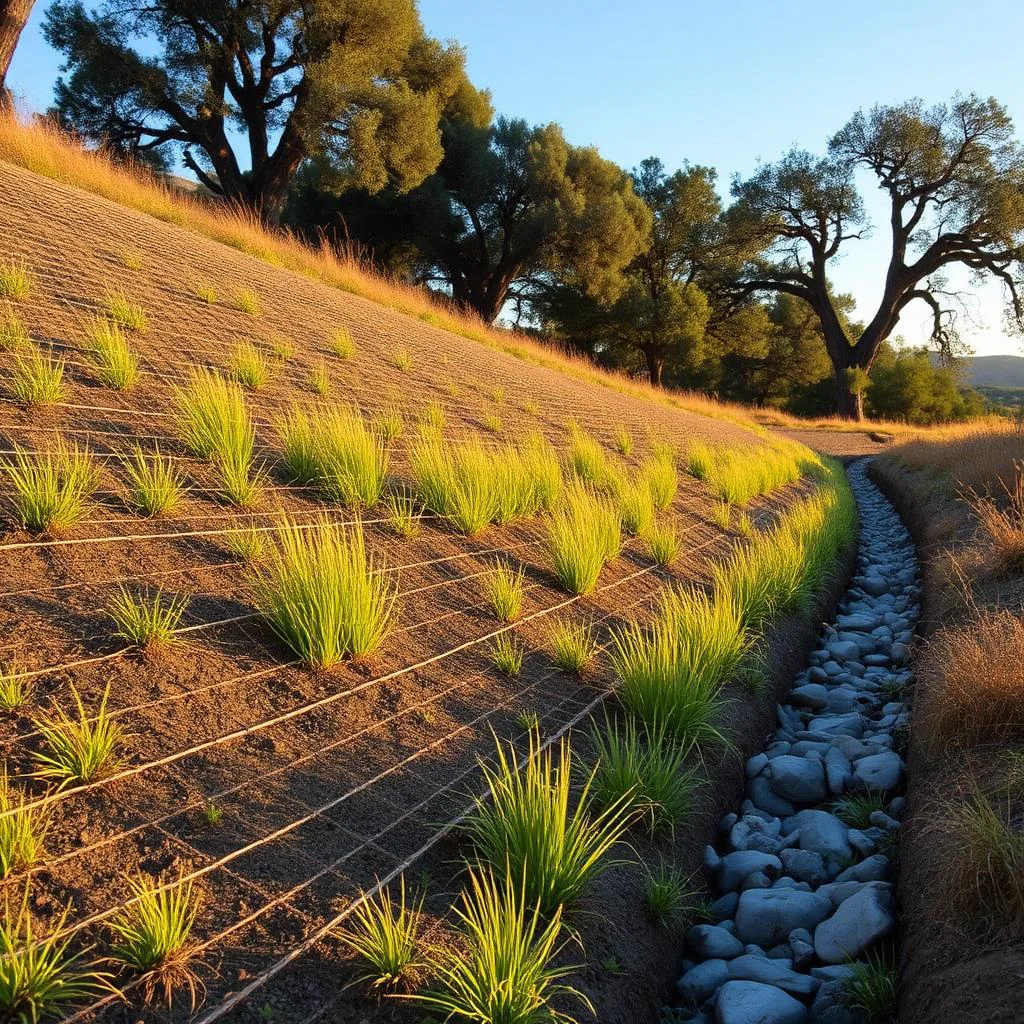
Erosion Control Plants in Orangevale, CA
Plants Are the Part That Holds for Good
Fabric and netting buy time on a bare slope, but plants are what actually hold the ground once that fabric breaks down. Picking the right species, and spacing them right, is what decides whether it works.
No obligation. Licensed CA landscape contractor.
The best erosion control plants for an Orangevale hillside are deep-rooted, drought-tolerant California natives. Good picks include creeping sage, coyote brush, California buckwheat, ceanothus, and manzanita. Fabric and netting buy time on a bare slope, but plants hold the ground for good. Choosing the right species, and spacing them well, decides whether a hillside planting works.
Soil on a bare hill can move with one hard rain. Roots slow that loss by holding soil in place. Leaves and mulch help soften the splash of falling rain. A good plan uses both. It also leaves room for each plant to grow without leaving wide strips of bare ground.
Why Plant Choice Matters More Than Fabric on an Orangevale Slope
Jute, coconut coir netting, and straw wattles all break down within a year or two. By the time they are gone, the plants underneath need to be doing the real work of holding soil in place. A slope planted with the wrong species, or spaced too far apart, can still erode even with fresh fabric covering it, since fabric only slows water. It does not grip soil the way living roots do.
On an Orangevale slope, a quick cover is useful while new roots take hold. It is not the whole plan. Rain can still find a path through gaps and carry loose soil downhill. Plant cover needs time to spread across those gaps. Pick plants that fit the sun and soil from the start, so they can keep growing after the temporary cover is gone.
Plants That Hold Slopes in Orangevale
- Creeping sage ('Mrs. Beard'): a low groundcover that spreads fast and has purple spring flowers
- Coyote brush ('Pigeon Point' or 'Twin Peaks'): an evergreen with deep roots and a neat, low habit
- California buckwheat: a tough, sun-loving shrub with pale pink and white flowers
- Ceanothus (California lilac): deep roots and spring blue flowers. Pick a type that handles inland heat, since some do better with afternoon shade
- Manzanita: evergreen, deep-rooted, and low in water needs
- Toyon and western redbud: larger natives for slopes with room to fill
The California Native Plant Society's guide to plants that hold hot, sunny slopes explains why these plants work and how fast they spread.
Which ones fit your yard depends on the slope, the sun, and the soil. We match the plant list to your lot.
What Makes a Plant Good at Holding a Slope
- Dense, fibrous roots that spread sideways and knit soil together, rather than a single taproot that only holds one point
- Fast establishment, so roots are doing real work within the first year instead of the third
- Evergreen foliage, so the plant holds ground year round instead of going dormant right when winter rain hits hardest
- A spreading or mounding habit that closes gaps between plants as it matures
Roots are the part you cannot see, but they do the holding. A dense spread of roots helps slow shallow soil loss. Leaves and branches also slow rain before it hits the ground. Check the mature size before planting. A shrub that stays low is easier to fit near a path, while a tall one needs more room.
Spacing Plants Close Enough to Actually Work
A hillside planted with the right species but spaced too far apart still erodes, since bare soil between plants washes out before roots ever reach it.
- Plant in a staggered, offset pattern rather than straight rows, so roots spread to cover the whole slope face, not just a line down the middle.
- Space plants close enough that their mature spread overlaps slightly, closing gaps instead of leaving bare soil between full-grown plants.
- Cover the entire slope face, not just the areas that look the worst. Erosion often starts in spots that looked fine the year before.
- Fill any gap that opens up fast. A bare patch becomes a new erosion channel within one storm season.
- Mulch bare soil between young plants so rain does not wash it out while roots grow.
Spacing is not the same for every plant. A groundcover that spreads six feet needs a different layout from a narrow shrub. We look at each plant's grown size, then place it so nearby roots and leaves can meet over time. Keep the spaces between young plants covered as they fill in. Pay close attention to the top of the slope, where water may first start to run.
Matching Plants to Which Way Your Orangevale Slope Faces
- South and west facing slopes get the most sun and heat, so tough picks like buckwheat, coyote brush, and creeping sage hold up best there
- North and east facing slopes stay cooler and hold moisture longer, which suits plants that like a bit more shade
- A slope with mixed exposure often needs a mixed plant list rather than one species all the way across
Walk the slope at more than one time of day. A spot that looks sunny in the morning may be shaded by a fence later. The top of the hill may dry much faster than the bottom. A plant that does well at the bottom may struggle at the top. Place thirsty plants only where the soil can support them without soaking dry-loving roots nearby.
Plants Alone Do Not Fix a Very Steep Slope
Roots help, but they cannot hold every hillside. A very steep bank may need grading, a retaining wall, or terracing first. Plants then finish the job. Fall is the best time to plant on a slope, since winter rain waters new roots for free.
Watch where water enters the bank. If runoff pours from a roof or a paved area onto bare soil, plants alone may not stop the damage. The water may need a safer path first. On a steep bank, loose soil can also slide before new roots are strong. We look at the shape of the hill and the flow of water before choosing plants.
Fire risk matters too. In Orangevale, dry plants close to a home can add fuel. Choose healthy plants suited to the site and leave space between them where needed. Do not pack tall shrubs tight against a building just to cover bare ground. A slope plan should help hold soil without making the yard harder to protect.
Plant-Based vs Fabric-Based Erosion Control
| Plants | Fabric and Netting | |
|---|---|---|
| How long it lasts | Permanent once established | Breaks down within one to three years |
| When it starts working | Takes a season or two to establish | Works immediately after installation |
| Long-term holding power | Strong, roots grip soil indefinitely | None on its own once it breaks down |
| Best used as | The permanent fix | Temporary cover while plants establish |
Plant choice is only half the picture on a steep lot. Our guide to how steep a slope can be landscaped covers the grading side of the same problem. For the full approach to hillside work in Orangevale, from grading to planting, see our hillside landscaping work.
All Hillside Landscaping Services in Orangevale
Back to Hillside Landscaping in Orangevale, CAPlant Your Slope So It Actually Holds
We choose and space erosion control plants to match your slope's exposure and steepness in Orangevale.
Mon–Fri, 7am–5pm. Licensed CA landscape contractor.