
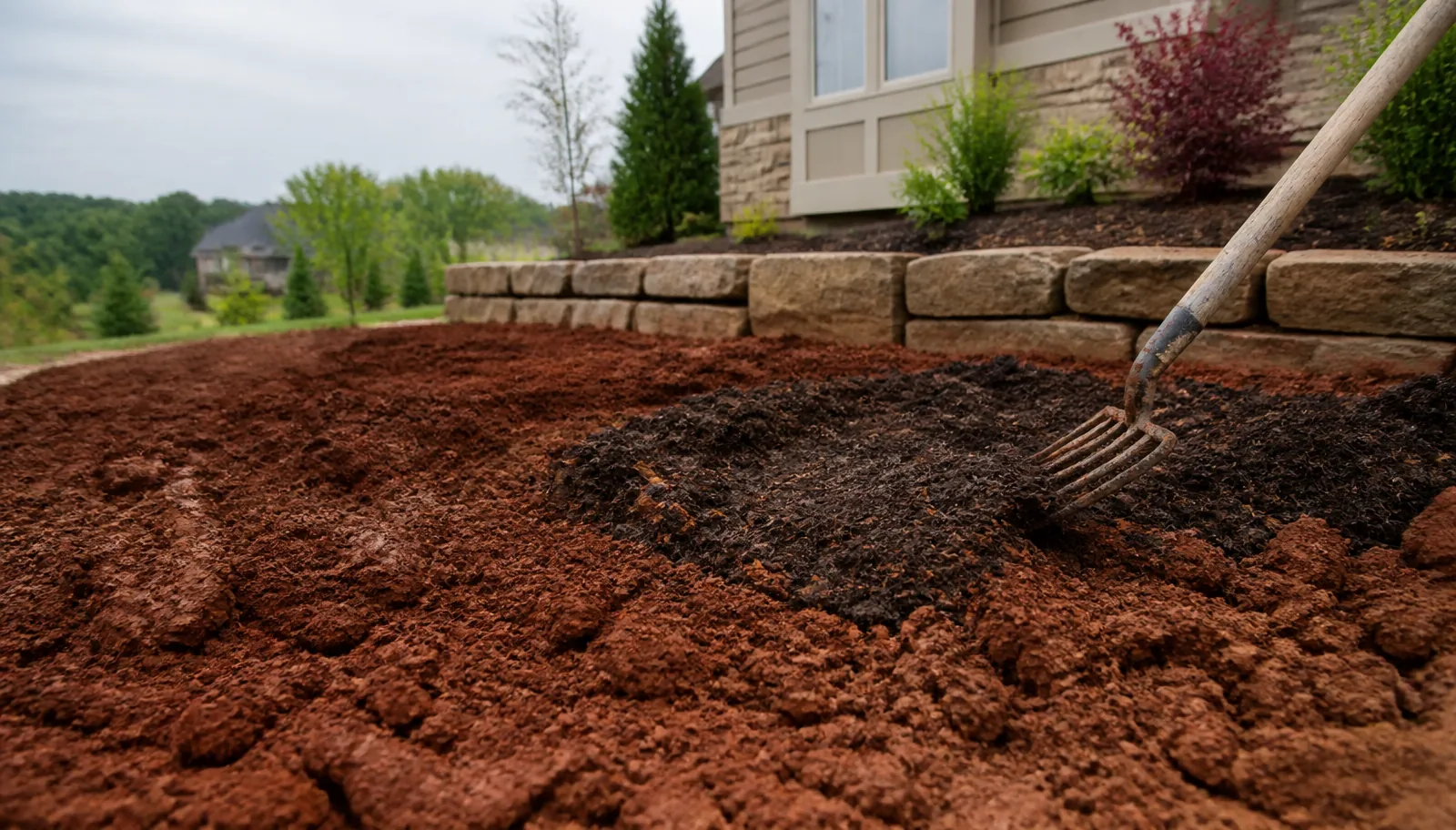
clay soil landscaping in Orangevale, CA
Landscaping That Works With Orangevale's Clay, Not Against It
Almost every yard in Orangevale sits on dense clay soil. Landscaping that ignores it fails within a few seasons. Landscaping that plans for it lasts for decades.
No obligation. Licensed CA landscape contractor.
Clay soil landscaping means choosing plants, drainage, and prep work that account for how clay behaves, instead of treating it like any other dirt. Clay holds water longer than sandy soil, resists new roots, and swells and shrinks with the seasons. A yard designed around those facts holds up for decades. A yard designed without them usually needs a redo within a few years.
What Makes Clay Soil the Default in Orangevale
Most Orangevale properties sit on dense clay-loam soil, a mix of fine clay particles and loam that drains slowly and compacts easily. It is not bad soil. It actually holds nutrients well. The trouble is texture, not nutrition. Water struggles to move through it, roots struggle to push into it, and it hardens like brick once summer heat dries it out.
How to Tell If Your Yard Has Clay Soil
A simple test tells you what you are working with before you plant anything.
- Squeeze a handful of moist soil. Clay holds its shape in a tight ball instead of crumbling apart
- Water sits on the surface for a while after rain or irrigation instead of soaking in quickly
- The ground cracks in dry summer heat, then turns sticky and heavy again after winter rain
- Digging feels like cutting through dense, sticky material rather than loose, crumbly dirt
Amending Clay Soil Before You Plant
Adding organic matter is the most reliable way to make clay soil easier to work with. Compost worked into the top several inches loosens the structure, improves drainage, and gives roots room to spread. The UC Master Gardener Program's guide to managing and amending soil confirms that organic matter is the most effective fix for difficult clay texture, and warns against shortcuts like adding sand, which can make clay soil worse instead of better.
Amending the whole planting area, not just individual holes, matters most. A rich pocket surrounded by unchanged clay still traps roots and water in one spot instead of letting them spread naturally.
Timing the work also matters. Clay soil amends best when it is moist but not soggy, which usually means working it in fall or early spring rather than the middle of a dry Orangevale summer, when the ground bakes hard and resists a shovel almost as much as it resists roots.
Plants That Actually Thrive in Orangevale Clay
Some plants tolerate clay far better than others. Choosing the right ones from the start avoids years of struggling to keep the wrong plant alive.
- California natives adapted to heavy soil, since they evolved alongside it
- Mediterranean plants used to dense, slow-draining ground in their native climate
- Deep-rooted shrubs that can push through clay once established
- Plants labeled tolerant of both wet winters and dry summers, the exact swing Orangevale clay goes through
Plants that need fast-draining, sandy conditions are the ones that struggle most. Lavender and rosemary, for example, can rot in heavy clay that stays wet too long, even though they tolerate drought well once established in the right soil. Matching a plant's native soil preference to what Orangevale actually offers prevents years of replacing plants that were never going to work here in the first place.
Designing Drainage Around Clay Instead of Fighting It
Clay soil moves water slowly, so a yard design has to plan for where that water goes instead of hoping it disappears. Grading that slopes away from the house, French drains in low spots, and raised beds for plants that need faster drainage all work with clay's nature rather than against it. Skipping this step is one of the most common reasons a new landscape develops soggy patches or root rot within the first year or two.
- Grade the yard so water flows away from the house and toward a planned drainage point
- Use French drains in spots where water collects instead of letting it pool near roots or foundations
- Raise beds for plants that need faster drainage than surrounding clay can offer on its own
- Break up compacted clay layers under new beds so water has somewhere to go besides the surface
How Clay Soil Shapes Hardscape Choices in Orangevale
Patios, walkways, and retaining walls all need a stable base, and clay's swelling and shrinking makes that harder to achieve than in sandy soil. A proper base of compacted gravel, correct footing depth on any wall, and control joints in poured concrete all account for the ground moving slightly through the year. Skipping these steps on clay soil is why cracked patios and leaning walls show up so often in older Orangevale yards.
A full landscape installation in Orangevale plans soil prep, plant choice, drainage, and hardscape together, rather than treating clay soil as an afterthought once the design is already set.
Common Clay Soil Mistakes Orangevale Homeowners Make
A few mistakes show up again and again in yards that were not designed around the soil.
- Planting straight into unamended clay and hoping the plant adapts on its own
- Overwatering a struggling plant, which only makes slow-draining clay hold more water
- Adding sand to loosen clay, which often creates a dense, concrete-like mix instead
- Skipping grading and drainage planning, then dealing with pooling water every winter
Most of these mistakes trace back to treating clay soil like an obstacle to work around instead of a starting point to design for. The second approach is what actually holds up over time.
All Landscape Installation Services in Orangevale
Back to Landscape Installation in Orangevale, CAGet a Yard Designed for Orangevale's Soil
McGuire Earth Works Inc. plans every yard around the clay underneath it. Call (916) 404-0944 for a free estimate.
Mon–Fri, 7am–5pm. Licensed CA landscape contractor.