
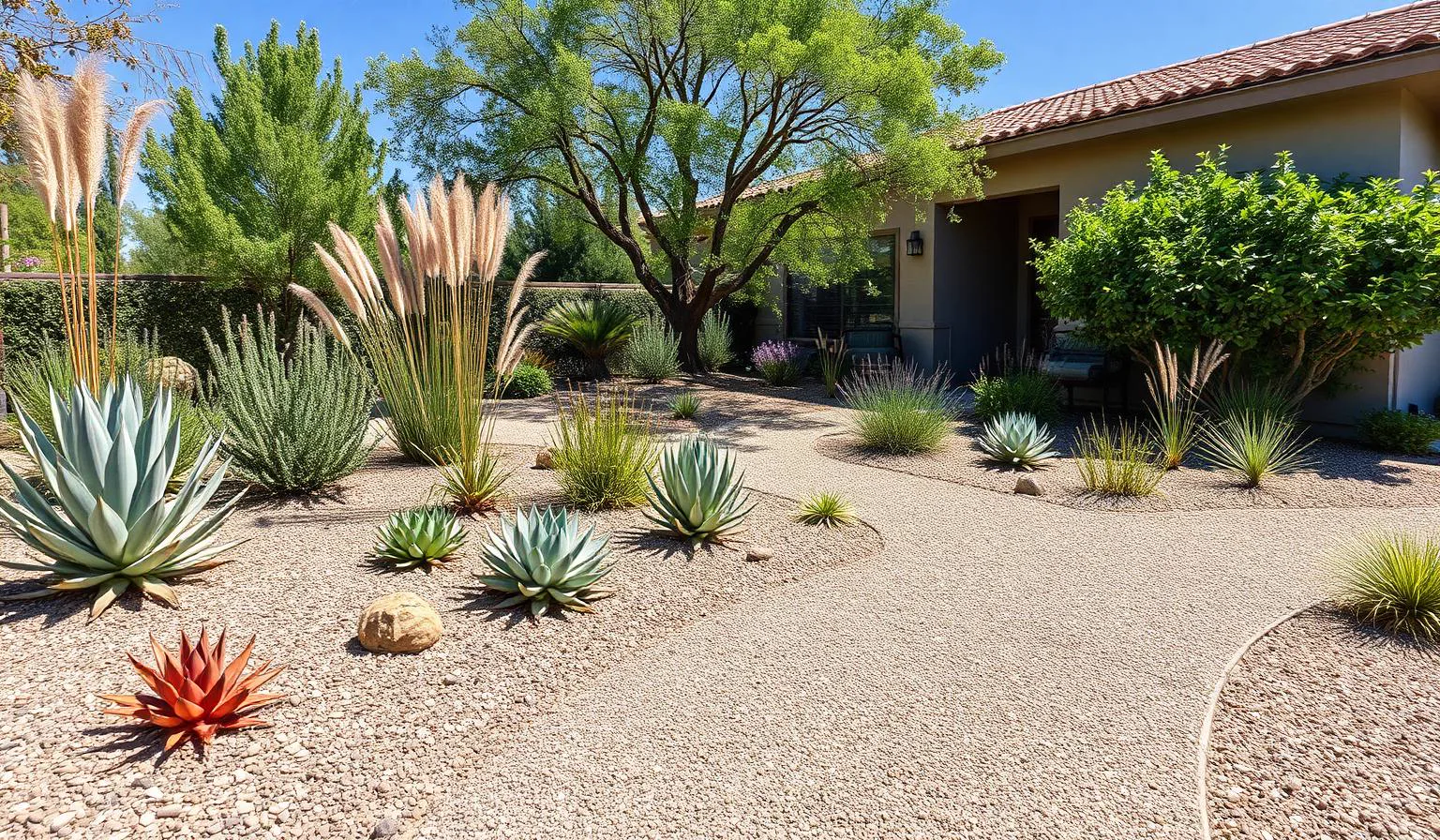
drought-tolerant landscaping water savings in Orangevale, CA
How Much Water Does a Drought-Tolerant Yard Actually Save?
Outdoor irrigation is one of the biggest pieces of a home's water use. Here's what the numbers say, and how a drought-tolerant yard changes them.
No obligation. Licensed CA landscape contractor.
Drought-Tolerant Landscaping Water Savings in Orangevale: The Quick Answer
Outdoor irrigation is a huge share of home water use, and it gets bigger in dry climates. Homes with in-ground sprinkler systems reportedly use about 50% more water outdoors than homes without them. A big reason is that so much of the water applied never reaches plant roots at all. It evaporates, blows away, or runs off before it does any good.
Swapping thirsty turf for drought-tolerant plants cuts into that demand directly, because the plants simply need less water to begin with. No source puts one exact percentage on the savings from a drought-tolerant yard, so we will not invent one here. What the numbers do show clearly is where the water goes, and how much room there is to waste less of it. For most Orangevale homes, that room turns out to be surprisingly large.
How Much Water Does Outdoor Irrigation Actually Use?
The EPA's guide to outdoor water-efficient landscaping puts real numbers on it. U.S. households use roughly 26.6 billion gallons of water a day, and about 8 billion of those gallons go outdoors. That works out to around 30% of household water use nationwide. In dry climates, the share climbs to as much as 60% of a home's total use.
The same guide estimates the average American home uses about 50,500 gallons of water outdoors per year, mostly for irrigation. Sacramento Valley summers are about as dry as it gets, running from June into September with next to no rain. That puts Orangevale yards squarely in the kind of climate where outdoor use pushes toward the high end of that range. When a lawn needs water every day just to stay alive, the gallons add up fast. A yard that only needs a deep drink now and then tells a very different story by the end of the season.
Where Most of That Water Goes to Waste
Using a lot of water is one thing. Losing it before it helps a single plant is another. The EPA guide points to a few places where outdoor water gets wasted, and they are more common than most homeowners expect.
- Up to 50% of the water applied outdoors is lost to evaporation, wind, runoff, or watering beyond the plant's root zone.
- Homes with in-ground sprinkler systems reportedly use about 50% more water outdoors than homes without them.
- Watering on a fixed timer schedule instead of matching actual plant needs is a common cause of this kind of waste.
Put those together and the picture is clear. A yard can be watered on schedule every week and still waste close to half of what it uses. The problem is not just how much water a yard gets. It is how little of that water ever reaches the roots that need it. Fixing the schedule alone helps. Fixing what is planted helps even more, because a plant that needs less water has less water to lose in the first place.
Why Drought-Tolerant Plants Change the Equation
Drought-tolerant plants attack the problem from the other side. Instead of delivering water more efficiently to plants that need a lot of it, they lower the amount of water the yard needs in the first place. The baseline demand drops, no matter how that water gets applied.
The EPA guide describes a drought-tolerant landscaping example that needs little to no supplemental water during peak summer. That is one documented example, not a universal percentage, and the guide does not put a single savings number on drought-tolerant yards in general. But the direction is hard to argue with. A yard full of plants built for dry summers asks for far less water than a lawn that was never meant for this climate. And once those plants are established, the gap between what the old yard needed and what the new one needs shows up month after month, not just in a heat wave.
Smart Controllers Add Another Layer of Savings in Orangevale
Plants are only half of the equation. How the yard gets watered matters just as much. The EPA guide says WaterSense-labeled irrigation controllers save water, time, and money compared with conventional controllers, though it gives no specific figures. The idea is simple: a smart controller waters based on real conditions instead of a fixed schedule that runs the same way in April as it does in August.
Pairing drought-tolerant plants with a smart controller addresses both sides of the waste problem at once. The plants lower what the yard needs. The controller makes sure the water that does get applied actually matches those needs. For an Orangevale yard, that combination is where the real savings live.
Why This Matters During Peak Summer
The EPA guide makes one more point worth knowing. Peak summer demand can require water utilities to increase their capacity to three to four times their winter level. That is a general point about water systems under summer demand, not a claim about any specific local agency. Still, it shows how much strain outdoor irrigation puts on the whole system when every lawn in town needs water on the same hot afternoons.
Every yard that needs less water in July and August eases that peak a little. A drought-tolerant yard does its part exactly when demand is highest, which is also when water is most expensive to supply and most precious to save. That timing is a big part of why water-wise yards make sense here, not just in theory but in practice.
Starting Your Water-Wise Yard in Orangevale
If your yard still runs on thirsty turf and a fixed timer, the numbers above are working against you every summer. Our drought-tolerant landscaping in Orangevale page walks through how a full redesign comes together, from plant selection to drip irrigation. If your project starts with an existing lawn, our lawn removal guide covers the first step. Bigger projects also need to meet the state's MWELO water budget rules, which set a water use cap for new and renovated landscapes.
Ready to see what a water-wise yard would look like on your property? Call McGuire Earth Works Inc. at (916) 404-0944 for a free estimate on a drought-tolerant redesign. We will walk the yard, talk through the options, and give you a clear plan before any work starts.
All Drought-Tolerant Landscaping Services in Orangevale
Back to Drought-Tolerant Landscaping in Orangevale, CAReady for a Yard That Uses Less Water?
McGuire Earth Works Inc. designs drought-tolerant yards in Orangevale. Call (916) 404-0944 for a free estimate.
Mon–Fri, 7am–5pm. Licensed CA landscape contractor.