
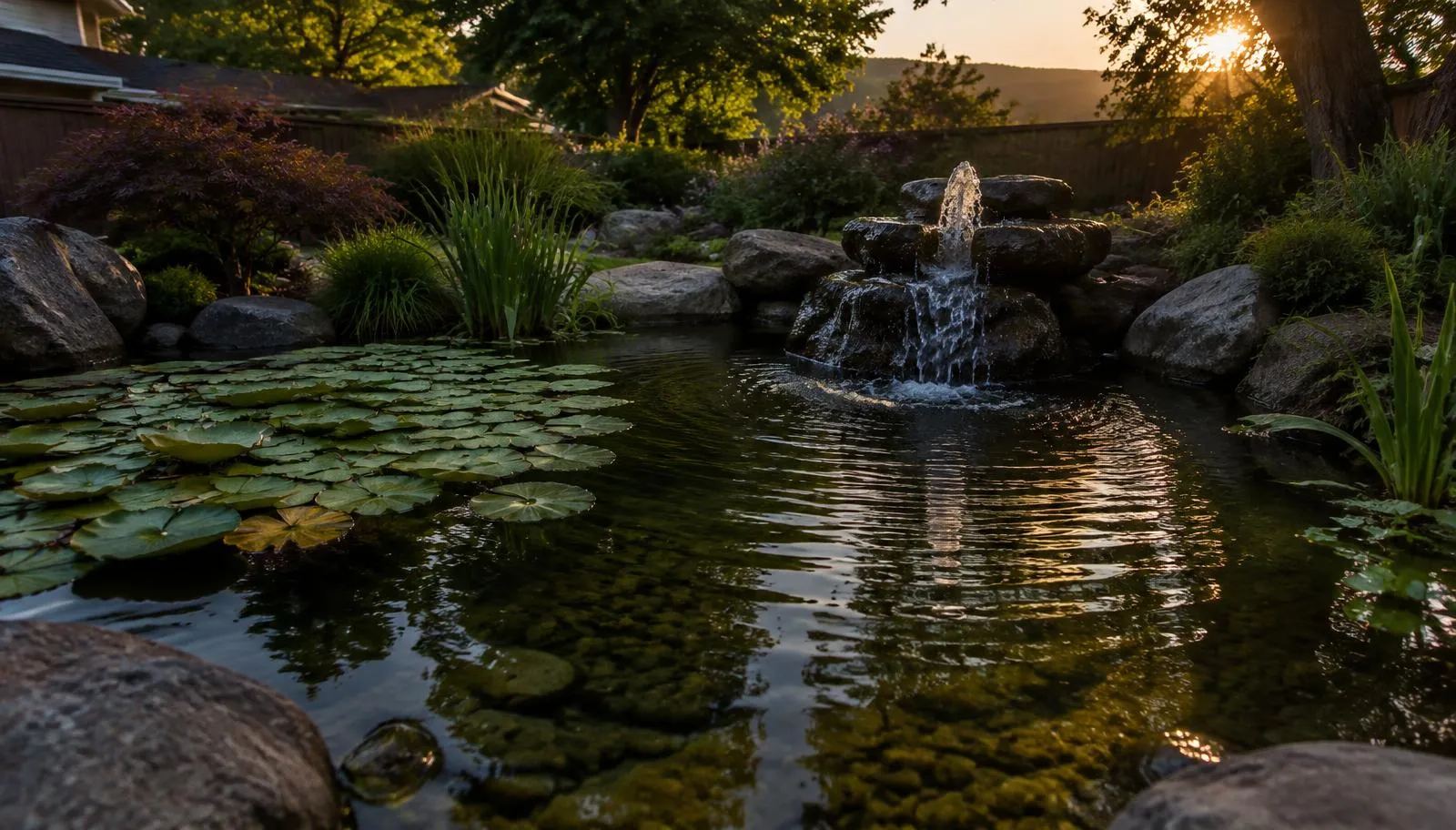
pond and fountain water clarity in Orangevale, CA
What Actually Keeps Pond Water Clear
Cloudy or green water usually comes down to a few simple causes. Here is what drives it, and what helps, in an Orangevale yard.
No obligation. Licensed CA landscape contractor.
Why Pond and Fountain Water Turns Cloudy or Green
Here is the short version. Green water comes mostly from algae. Algae are tiny plants that float in the water. Like any plant, algae need two things to grow. They need sunlight, and they need food. That food comes from nutrients in the water.
Cloudy water is a little different. It is often caused by fine bits of dirt or clay stirred up in the water. It can also come from leaves and other debris breaking down. Brown or gray water often points to one of these.
Either way, the water itself is not the problem. Something is feeding it. Green water means something is feeding algae. Cloudy water means something is stirring things up or rotting. When you find what is feeding the problem, you can fix it at the source instead of fighting the same color every few weeks.
Clear Is Not Always the Healthiest Goal
Many people want water so clear they can see every stone on the bottom. For some water features, that is a fine goal. For others, it is not the healthiest one.
Iowa State Extension's pond algae guide makes this point for ponds with fish. It says that if you want good fish habitat, clear water should not be your goal. It suggests that about 15 to 25 percent of the water surface should have some kind of plant growth. Those plants give fish shade, food, and places to hide.
A fountain is a different case. So is a pond with no fish. There is no habitat need there, so the goal can be simpler. Clearer water makes good sense for these features. Just know which kind of feature you have before you decide what "healthy" looks like.
What Feeds Algae
Nutrients are the fuel for algae. The more nutrients in the water, the more algae can grow. Most nutrients come from a few common places in a backyard.
Leaves and debris are a big one. When leaves fall in and sink, they rot. As they break down, they release nutrients into the water. Fertilizer is another. If you feed a lawn or bed near the water, rain and sprinklers can wash some of it in. Grass clippings blown into the edge do the same thing.
Then there is the sun. Algae use sunlight to grow. A pond or fountain that sits in full sun all day gives algae lots of energy. Still water in full sun is the easiest place for algae to take over.
Put it together, and the rule is simple. More nutrients plus more sun equals more algae. Cutting back on either one helps. Cutting back on both helps the most.
Circulation and Aeration Help the Most
Moving water is one of the best tools for clear water. Algae like calm, still water where they can settle in and grow. When water keeps moving, it is much harder for algae to get a foothold.
Aeration means adding air to the water. A waterfall, a fountain spray, or a bubbler at the bottom all do this. The Iowa State guide lists aeration as a way to prevent problems. It says aeration adds oxygen to the water and helps bind phosphorus to the mud at the bottom. Phosphorus is one of the main nutrients algae feed on. When it stays locked in the bottom, there is less of it floating where algae can use it.
That is why we plan pumps and moving water into the design from the start. A feature that circulates well stays clearer.
Orangevale Summer Heat Speeds This Up
Orangevale summers are long and hot. Many days pass 100 degrees from June through September. That heat changes how a water feature behaves.
First, warm water helps algae grow faster. Second, heat speeds up evaporation. As water leaves, the nutrients stay behind. So the water that is left has more food in it for algae. Third, warm water holds less oxygen than cool water. That makes moving water even more important in summer.
This is why a pond that looked great in April can turn green fast in July. Nothing went wrong in the spring. The real heat just arrived and pushed algae into high gear.
A Pondless Waterfall Skips This Problem Almost Entirely
A pondless waterfall works in a different way. The water runs down over stones and drains into a basin hidden under the ground. A pump sends it back to the top. There is no open pool sitting in the sun.
Without open standing water, algae have far less of a foothold. Leaves are easier to keep out. Sun cannot heat a big open surface. And the water is always moving. For many Orangevale yards, that makes a pondless waterfall the easiest way to enjoy the sound of water.
If you are choosing between the two, our guide on pondless waterfall vs. pond walks through the trade-offs.
Simple Habits That Help
A few small habits go a long way toward clearer water:
- Skim leaves and debris out before they sink and rot
- Keep fertilizer and grass clippings away from the water's edge
- Give the feature some shade during the day if it sits in full sun
- Add floating plants that shade part of the surface, without covering all of it
- Keep the pump running so the water stays moving
These habits work best together. No single step keeps water clear by itself. Small, steady habits stop the problem before it starts, which is far easier than clearing a green pond in August.
For more ways to plan around the heat, see our water feature ideas for hot summers. Then call McGuire Earth Works Inc. at (916) 404-0944 for a free estimate. We will design a water feature that handles summer heat well from the start.
Frequently Asked Questions
Should my pond water be perfectly clear?
What causes algae in a pond or fountain?
Does moving water get less algae than still water?
All Water Features Services in Orangevale
Get a Water Feature Built Right
McGuire Earth Works Inc. designs and installs water features across Orangevale. Call (916) 404-0944 for a free estimate.
Mon–Fri, 7am–5pm. Licensed CA landscape contractor.