
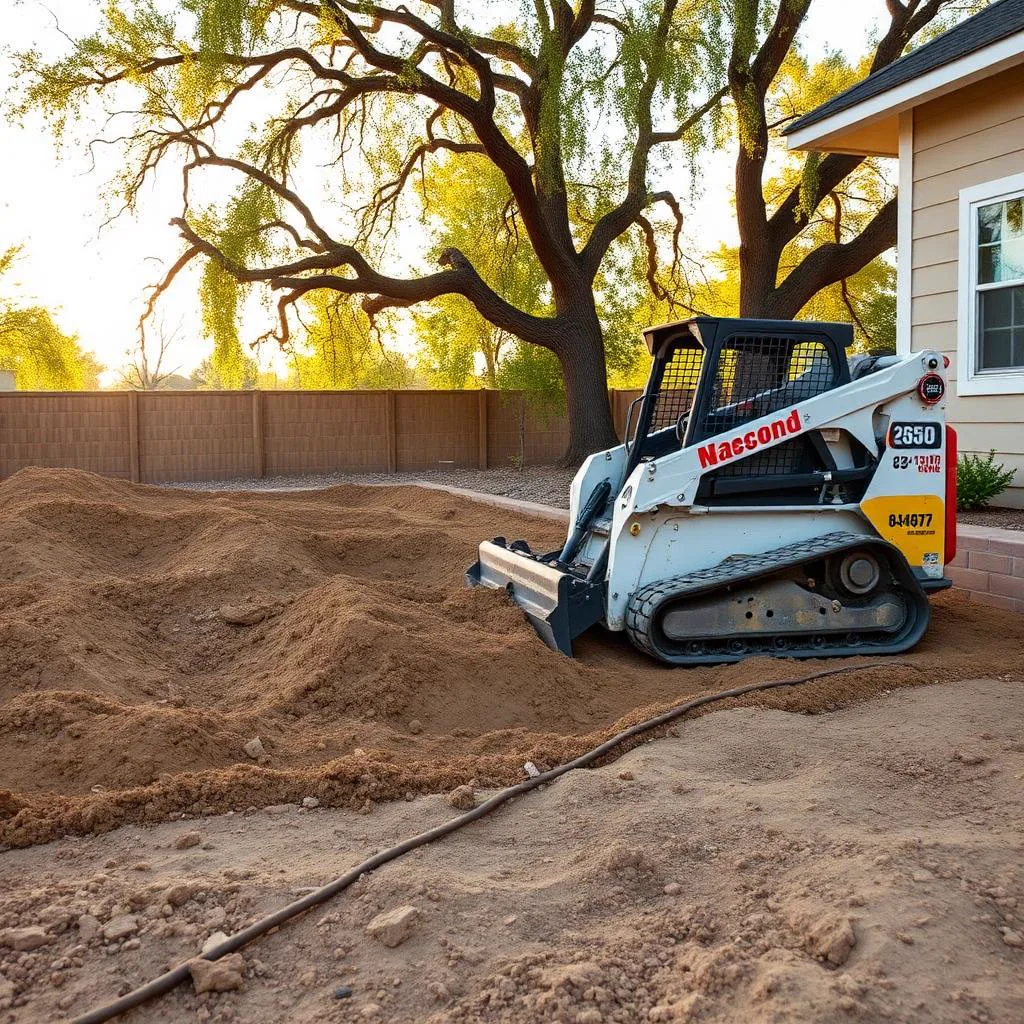
builder-grade soil in Orangevale, CA
Your New Yard Might Be Growing in the Wrong Dirt
New construction often leaves behind compacted dirt with almost no real topsoil. Here is how to tell, and what it takes to fix it before you plant.
No obligation. Licensed CA landscape contractor.
What Is Builder-Grade Soil?
Builder-grade soil is what is left behind after a house gets built. Heavy equipment drives over the lot again and again during construction. Much of the original topsoil gets scraped off, sold, or buried under subsoil. What is left on top is often hard, compacted dirt with almost no organic matter in it. It looks like a yard, but it does not act like one.
Builders are not required to leave rich topsoil behind, and most do not. Heavy equipment has to drive across the lot to frame the house, pour the driveway, and run utility lines, and that equipment compacts the ground every time it passes. On top of that, topsoil stripped from the lot during grading is often sold or hauled off, since it has value on its own. What gets graded back over the lot before sod or landscaping starts is usually subsoil, sometimes mixed with leftover construction material. It is not a shortcut taken on purpose to cause problems. It is simply the order construction happens in, and landscaping comes after the equipment is already done with the lot.
Signs Your Orangevale Yard Has Builder-Grade Soil
- Water pools near the foundation instead of draining away
- The ground feels like concrete a few inches down when you probe it
- Chunks of construction debris turn up when you dig a planting hole
- Grass seed or sod struggles to root even with regular watering
- Bare, thin patches that never fill in no matter what you plant
Any one of these on its own is not proof. Several of them together, in a yard built in the last few years, usually point to builder-grade soil rather than a watering or plant problem.
Builder-Grade Soil Is Not the Same as Clay Soil
Orangevale's native clay-loam soil and builder-grade soil are not the same problem, even though both end up dense and slow to drain. Clay soil is naturally heavy and holds water because of its mineral makeup. We cover that in our clay soil landscaping guide for Orangevale. Builder-grade soil is a different kind of damage. It is native soil that has been compacted by machine traffic and stripped of the topsoil layer that used to support plant roots. A newer home in Orangevale can sit on both problems at once: clay underneath, and construction damage on top of it.
Fixing Builder-Grade Soil the Right Way
- Probe the soil in a few spots with a screwdriver or soil probe to find how deep the compacted layer runs
- Rip or till the compacted layer rather than only working the top inch or two
- Bring in real topsoil where the original layer was stripped away or buried
- Mix in compost so the new and old soil layers bond instead of separating
- Re-grade the yard so water moves away from the foundation instead of pooling against it
A federal guide to protecting urban soil quality recommends breaking up compacted subsoil to a real depth, not just the surface, before any topsoil goes back down. Skipping that step is the most common reason a new lawn or planting bed in Orangevale fails twice in the same spot.
What Happens If You Skip Fixing It
Skipping soil repair rarely shows up on day one. New sod can look green for the first few weeks on top of compacted ground, since the roots have not yet had to push past the hard layer underneath. The trouble starts a season or two later, when roots that should be spreading down are still sitting shallow. A lawn planted straight into builder-grade soil often needs to be replaced twice, once right after move-in, and again a year or two later once the first attempt thins out.
The same compaction affects more than grass. A patio or walkway built on unaddressed compacted fill can settle unevenly as the ground finally shifts under it. Water that cannot soak into hard subsoil keeps running toward the lowest point in the yard, which in a lot of new builds is right along the foundation. Fixing the soil once, before anything goes in, almost always costs less than fixing a lawn, a patio, and a drainage problem separately a few years down the line.
Trees and shrubs face the same problem on a longer timeline. A new tree planted into builder-grade soil can survive its first two or three years on the moisture in its original root ball, then stall once those roots need to spread into native ground. Owners often blame the tree variety or a watering schedule, when the real cause is a compacted layer six or eight inches down that the roots cannot push through. Checking and fixing the soil before planting trees saves a multi-year wait to find out something is wrong.
Why This Matters Before You Plant in a New Orangevale Yard
Planting into builder-grade soil without fixing it first almost always costs more in the end. Roots that cannot push past a hard layer stay shallow, so plants dry out fast and lean or topple in wind. Grading problems left in place keep sending water toward the house instead of away from it. Our guide to the order landscape installation actually happens in explains why soil work has to come before plants, sod, or hardscape go in, not after.
Planning Landscape Installation in Orangevale
If your home was built in the last several years, it is worth checking your soil before you invest in new plants, sod, or a full yard build. Our landscape installation in Orangevale service starts every new-construction project with a look at what is actually under the surface, not just what the lot looks like on top.
All Landscape Installation Services in Orangevale
Back to Landscape Installation in Orangevale, CAFix the Soil Before You Plant
We check what is really under your new yard before anything goes in the ground. Call McGuire Earth Works Inc. at (916) 404-0944 for a free estimate.
Mon–Fri, 7am–5pm. Licensed CA landscape contractor.