
paver base depth in Orangevale, CA
The Base You Cannot See Is What Keeps Pavers in Place
A paver patio or driveway is only as good as what is under it. Orangevale clay makes base depth matter even more.
No obligation. Licensed CA landscape contractor.
Why Base Depth Matters
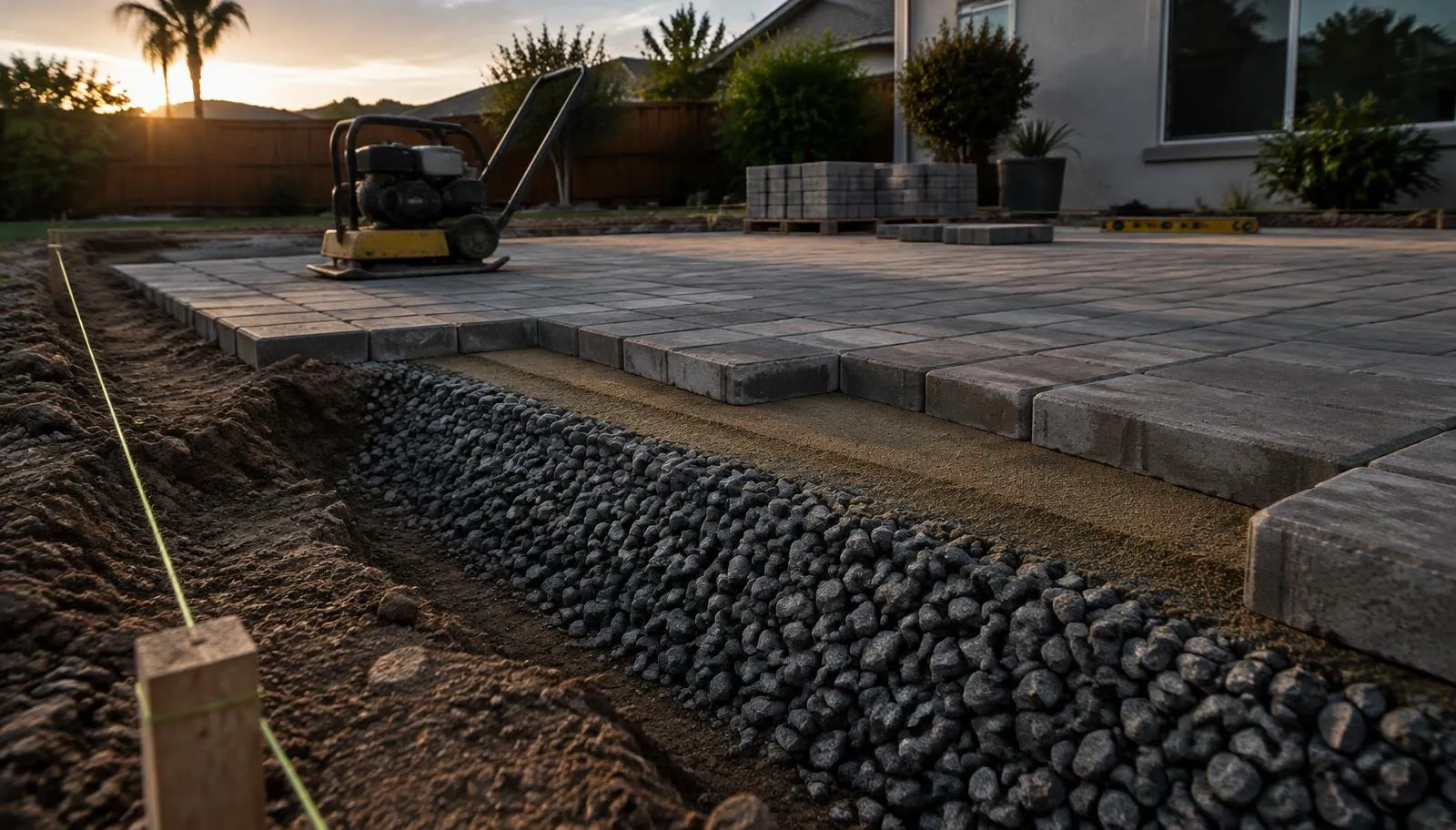
When you look at a paver patio, you see the pavers. But the pavers are just the top layer. The real work happens below them, in the base. The base is a layer of crushed rock that is packed down hard before any paver goes in.
That packed rock does two jobs. First, it spreads out weight. When you step on a paver, the base passes that weight over a wide area of soil. Second, it keeps the ground from shifting. Soil moves as it gets wet and dries out. A strong base keeps the pavers steady while the soil moves underneath.
A base that is too thin cannot do either job well. Over time the pavers start to sink. They rock when you step on them. Gaps open up as the pavers spread apart. The surface turns wavy. By then, the only real fix is to pull the pavers up and build the base again.
Patios Need Less Base Than Driveways
Not every paver job needs the same depth. The Interlocking Concrete Pavement Institute, called ICPI, sets the common guide. You can read it in ICPI's paver base construction guide.
The guide says patios, sidewalks, and walking areas should have at least 4 inches of base after it is packed down. That is on soil that drains well. A home driveway on soil that drains well should have at least 6 inches. The guide also says colder places, and soil that stays wet or is weak, need a base 2 to 4 inches thicker than that.
Why the difference? Weight. A person weighs a few hundred pounds at most. A car or truck weighs thousands. More weight pushes down harder on the soil. A thicker base spreads that weight over a bigger area, so the soil under it does not give way. A driveway built with a patio base will start to rut where the tires roll.
Orangevale Clay Adds a Wrinkle
Orangevale sits on clay-loam soil. Clay does not drain quickly. Water sits in it for a long time after rain. Clay also swells when it gets wet and shrinks when it dries out. That happens every year as the rainy winter turns into a long, hot summer.
Remember that the ICPI numbers assume soil that drains well. Orangevale clay often does not. So a base here often needs to run thicker than the bare minimum. This matters most under a driveway, where the weight is highest. A thicker base gives the clay below more room to move without pushing the pavers out of line.
Clay also changes how we dig, how we handle water, and what goes between the soil and the rock. To learn more, read our guide on hardscaping on clay soil.
What Goes Into a Good Base
A good base starts with the right rock. It should be crushed rock with sharp, angled sides. Those sharp edges bite into each other when the rock is packed down. They lock together like puzzle pieces. Smooth, round rock does not do this. Round stones roll against each other, so the base never gets truly firm.
The rock also goes in the right way. It is laid in layers, not dumped all at once. Each layer is spread out, then packed down with a heavy plate machine. Then the next layer goes on top. Packing in thin layers gets the rock tight all the way through. A thick pile packed only from the top stays loose at the bottom.
The last layer is a thin bed of coarse sand. It sits just under the pavers. Its job is to make a smooth, level surface so each paver sits flat. The sand is thin on purpose. The crushed rock below it carries the load.
Common Shortcuts That Cause Problems
Most paver problems trace back to a shortcut in the base. They are hard to spot once the pavers are down. Watch out for these:
- Skipping the packing step between layers, which leaves loose rock deep in the base
- Using round pea gravel or plain sand instead of crushed, angled rock
- Building the base too thin to save on rock and digging
- Skipping a fabric layer between soft or clay soil and the rock, so the two mix over time
- Not sloping the base a little, so water sits under the pavers instead of draining away
Each of these can look fine on day one. The trouble shows up a season or two later, after a few rounds of rain and heat.
Checking Base Depth Before the Pavers Go Down
Here is one step you can check yourself. Once the pavers go down, the base is hidden for good. There is no easy way to measure it later. So the time to check is before any paver is laid.
Ask your installer to show you the base depth. A tape measure held against a stake or the edge of the dig works well. You can see how deep the packed rock goes. Ask how many layers went in and how each one was packed. A good crew will be happy to show you. We do this on our own jobs in Orangevale so homeowners can see what they are paying for.
Even the Best Pavers Need the Right Base
It is easy to spend a lot of time picking pavers. Color, shape, and finish all matter. Some pavers handle heat better than others. Our guide to the best pavers for hot summers explains which ones stay cooler underfoot.
But even a paver built for Orangevale heat will fail early if the base under it is too thin. The paver is only as steady as what holds it up. Plan the base first, then pick the surface.
To build it right the first time, call McGuire Earth Works Inc. at (916) 404-0944 for a free estimate. A base built right means your patio or driveway lasts for years.
Frequently Asked Questions
Can I use sand instead of crushed rock for the base?
Does a thicker base always mean a stronger patio?
What happens if the base is too thin?
Get a Base Built to Last
McGuire Earth Works Inc. installs paver patios and driveways across Orangevale. Call (916) 404-0944 for a free estimate.
Mon–Fri, 7am–5pm. Licensed CA landscape contractor.