
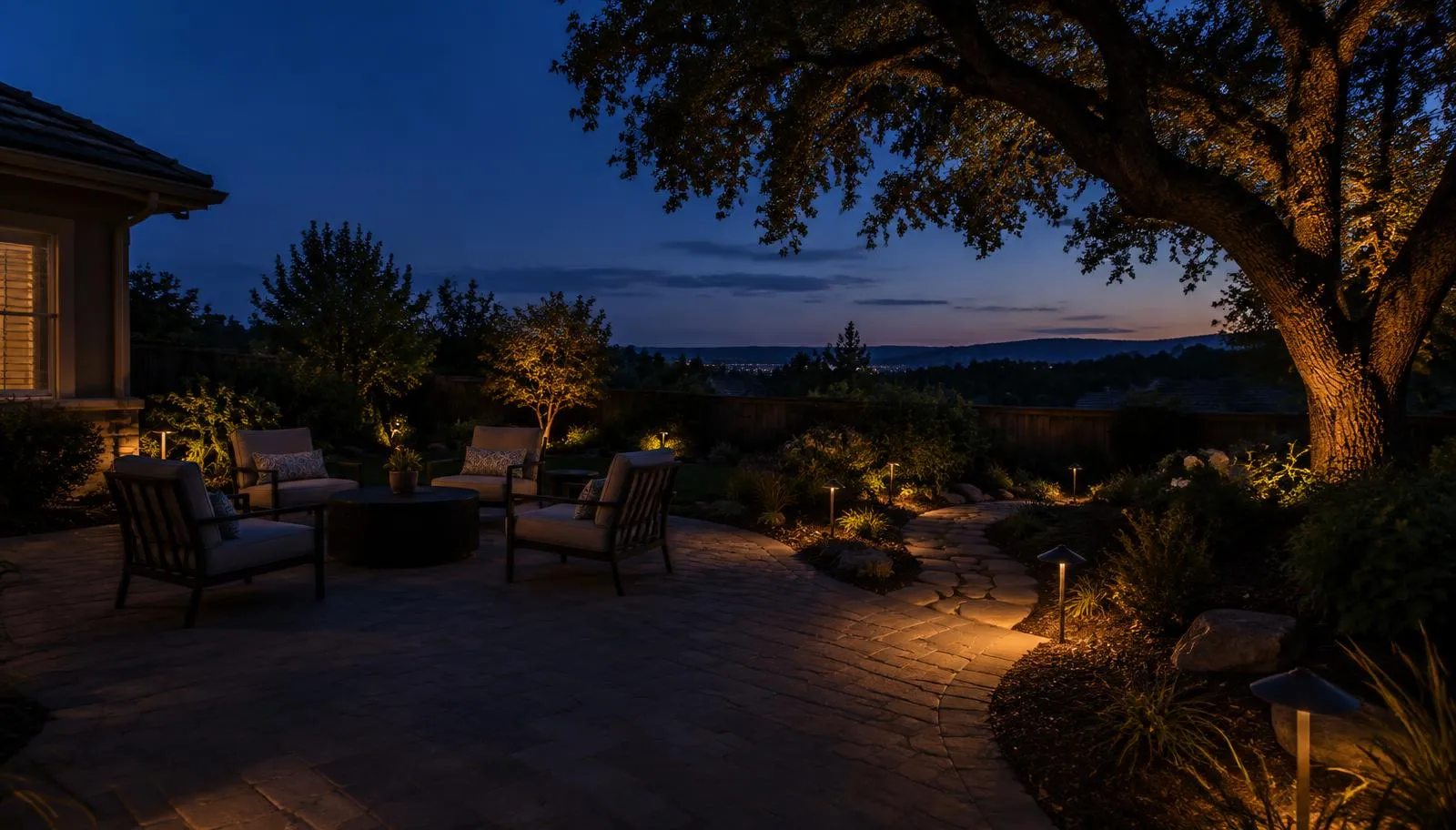
landscape lighting brightness in Orangevale, CA
Get the Brightness Right, Not Just the Bulb Count
Lumens and wattage tell you what a fixture puts out. Brightness is about what actually lands on the ground where you need to see. Here is how to think about it.
No obligation. Licensed CA landscape contractor.
Brightness Is Not the Same as Lumens or Wattage
People often shop for landscape lights by the numbers on the box. Two numbers show up the most. Lumens measure the light coming out of a bulb. Wattage measures the power going into it. Both are useful. Neither one tells you how bright the ground will actually look.
That is because brightness depends on more than the bulb. It depends on how high the fixture sits. It depends on how far apart the fixtures are. It depends on where each one is aimed. A bright bulb mounted high and far away can look dim on the path. A small bulb close to the ground can look plenty bright.
If you want to know more about those two numbers, read our guides on landscape lighting lumens and landscape lighting wattage. This page picks up where they leave off.
Footcandles Measure What You Actually See
A footcandle is the amount of light that lands on a surface. Think of a path, a step, or a patio floor. Your eye reacts to the light bouncing off that surface. So footcandles are much closer to what you see than lumens are. Lumens only count light leaving the bulb.
Lighting designers use footcandles to plan how bright each area should be. They set a target for each spot, then pick and place fixtures to hit it. These exterior lighting plan guidelines show how that works. They are written for business and town lighting plans, not home yards. Still, the ideas are a helpful guide. Lighting planning guidance suggests measuring light on the ground, area by area, and avoiding bright hot spots next to dark gaps.
You do not need a light meter at home. Just remember the idea. What matters is the light that lands, not the light the bulb claims to make.
Walkways and Steps Need the Most Even Light
Walkways and steps need brighter light than open lawn. People need to see where to put their feet. Even more than bright, the light needs to be even. A path with bright pools and dark gaps between them is a trip hazard. Your eyes adjust to the bright spot, then the dark spot looks even darker.
The same planning guidance asks designers to compare the brightest and dimmest spots in an area. The goal is to keep that gap small. That is a good general reference point for a home path too. It is not a home lighting code. It is just a smart way to plan.
- Space path lights so their pools of light meet or slightly overlap
- Light every step, or at least the edge of each step, on stairs
- Keep fixtures low so light falls on the path, not into eyes
- Light changes in level, like a curb or a single step, so they are easy to spot
Patios and Gathering Areas Want Softer Light
A patio or seating area does not need walkway-level brightness. People are sitting, not walking. They are talking, eating, or relaxing. Softer, warmer light works better here. It should light the space without shining into anyone's eyes while they sit.
Too much light on a patio causes two problems. First, it washes out the mood and makes the space feel like a parking lot. Second, a very bright patio makes the yard beyond it look pitch black. Your eyes cannot adjust to see past the glow. A little light out in the yard helps the whole space feel bigger and more open.
Many Orangevale homeowners spend summer evenings outside once the heat breaks. Soft patio light makes those nights easy to enjoy.
Accent and Uplighting on Trees and Walls
Uplighting a tree or a stone wall is about showing off a feature. It usually takes less light than people expect. The trick is aiming it carefully, not adding more. A single fixture at the base of an oak can light its trunk and branches beautifully.
The goal is a highlight, not a floodlight. When you blast a tree with too much light, it looks flat and loses its shape. A softer beam picks out the bark and leaves some shadow. Shadows give a yard depth at night. A few well placed accents look better than many bright ones.
Avoiding Glare and Light Spill in Orangevale Yards
Glare happens when a fixture is aimed so you can see the bulb itself. Your eye is drawn to the bright point instead of the light it throws. That makes everything around it look darker. Glare is the most common mistake in landscape lighting.
Shielded fixtures help a lot. A shield hides the bulb and points the light down where you want it. Fixtures aimed down at a path, or tucked behind a plant, also cut glare.
Light spill is the other problem. On an Orangevale lot, homes often sit close together. A light that spills into a neighbor's yard or a bedroom window is not a friendly light. The planning guidelines suggest keeping light at the edge of a home lot very low, close to the glow of bright moonlight. That is a good target to keep in mind, even though it is not a rule for your yard.
Getting the Brightness Right the First Time
You can change brightness after the lights go in. You can move a fixture, swap a bulb, or add a dimmer. But each of those takes more work than planning it right at the start. Moving a fixture can mean digging up wire and patching plants.
A walk-through of the yard at night catches most brightness problems before they are built in. During planning, we look at where you walk, where you sit, and what you want to show off. We check where neighbors' windows sit. Then we plan the light for each spot.
To get a lighting plan that fits your yard, call McGuire Earth Works Inc. at (916) 404-0944 for a free estimate. We will help you get the brightness right the first time.
Frequently Asked Questions
Is brighter always better for landscape lighting?
What is a footcandle?
Does light color temperature affect how bright a yard feels?
All Landscape Lighting Services in Orangevale
Get a Lighting Plan That Fits Your Yard
McGuire Earth Works Inc. designs and installs landscape lighting across Orangevale. Call (916) 404-0944 for a free estimate.
Mon–Fri, 7am–5pm. Licensed CA landscape contractor.