
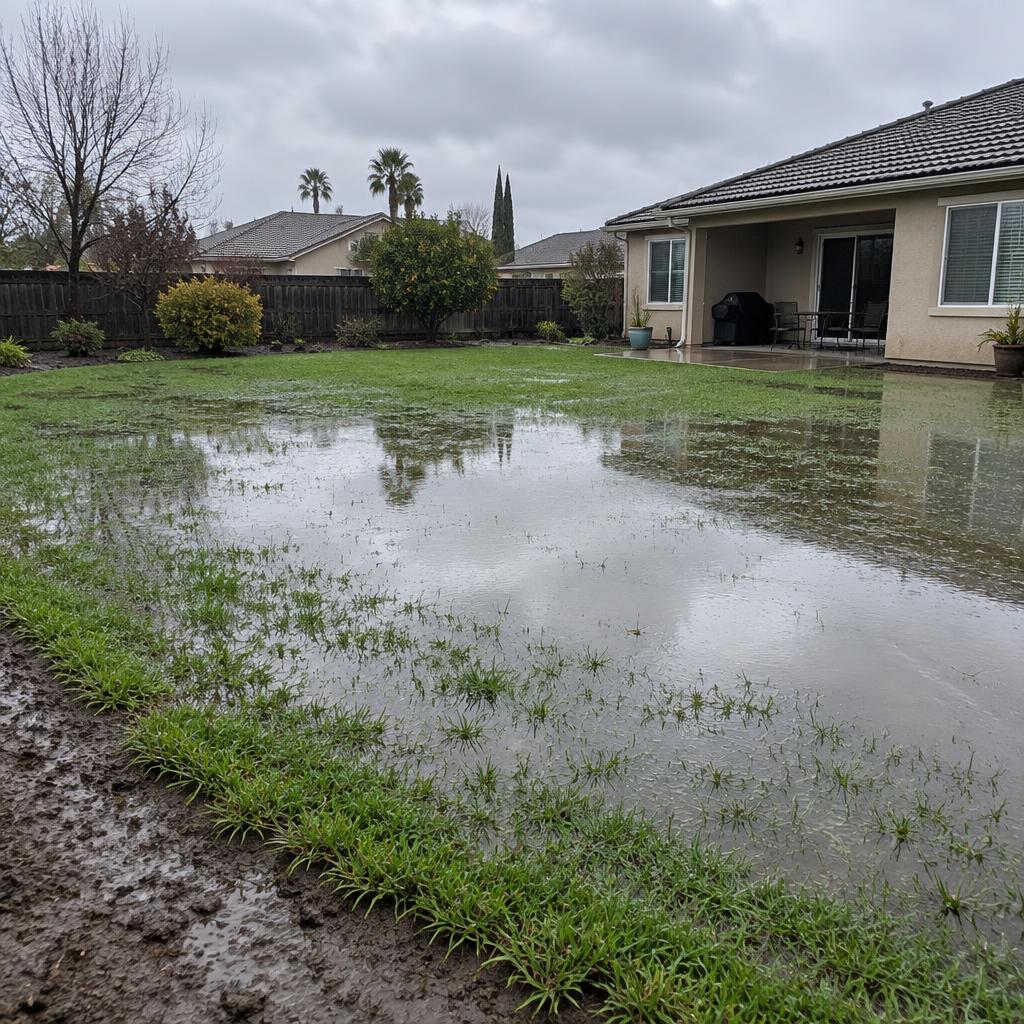
why yards flood in Orangevale, CA
Your Yard Floods for a Reason, and It Can Be Fixed
Every winter, the same backyards in Orangevale turn into shallow ponds. It is not bad luck. It is clay-loam soil and decades-old grading working together. Here is what is going on.
No obligation. Licensed CA landscape contractor.
It happens after almost every big storm. Water pools on the lawn, and the low side of the yard turns into a shallow pond that hangs around for days. Some Orangevale homeowners see it so often they think it is just how their yard is. It is not. Yards flood for clear reasons, and those reasons can be fixed.
Reason One: Orangevale's Clay-Loam Soil
Most of Orangevale sits on clay loam. Clay particles are tiny, and water moves between them very slowly. When a winter storm dumps an inch of rain in a few hours, the top of your soil cannot take it in fast enough. The extra water has nowhere to go, so it sits on the surface until it slowly seeps in or evaporates.
Curious what your soil is made of? The USDA keeps a free Web Soil Survey tool where you can look up your address and see the exact soil type on your lot. Most of our area maps out as clay loam.
Reason Two: Grading Done Once, Decades Ago
Most Orangevale homes were built in the 1980s and 90s. The builder graded each lot once to move water off the pad, and nobody has checked it since. Forty years of foot traffic, garden beds, fences, patios, and tree roots have nudged the ground since then. Slopes that used to work now send water into low spots. Some of those low spots are right against a back door or a patio.
Reason Three: Water Has No Way Out
Even with good soil and good grading, a yard floods when water has no path to leave. Maybe a neighbor's fence blocks the old drainage path. Maybe a patio was added across a slope that used to carry water away. Maybe the yard just ends in a bowl with no outlet. Water always finds the lowest point, and if that point is your lawn, your lawn is where it stays.
Why January Is the Worst Month for It
Orangevale's wettest stretch runs through winter. The clay is already soaked from earlier storms, so a January rain arrives with nowhere left to go. That is why the same yard can shrug off an October shower and then flood in January after the very same rain. Back-to-back storms are what push a wet yard into a flooded one.
Warning Signs to Watch For
- Puddles that last more than two days after a storm
- A lawn that feels spongy underfoot all winter
- Water creeping toward the slab, patio, or back steps
- Soil washing out along a fence line every big storm
- Grass that yellows in patches each winter and never fully bounces back
These signs point to the same root cause most of the time. We explain the soil side in detail on our clay soil drainage problems page.
What Fixes a Flooded Orangevale Yard
The fix starts with a plan, not a product. We map where the water lands, why it stops there, and where it should end up. Then we build that path. It might be a French drain, a catch basin at the low spot, or regrading the yard so it pitches away from the house. Often it is a mix. You can see the full toolbox on our drainage solutions page. And if the fix involves moving a lot of soil, our drainage permit guide explains when the county needs to sign off first.
Clay soil is not going away, and neither is winter rain. But a flooded yard is not permanent. Call us for a free estimate and we will show you exactly why your yard holds water and what it takes to drain it.
Frequently Asked Questions
Find Out Why Water Pools in Your Yard
McGuire Earth Works Inc. has drained flooded Orangevale yards since 1980. Call (916) 404-0944 for a free estimate before the next big storm rolls in.
Mon–Fri, 7am–5pm. Licensed CA landscape contractor.