
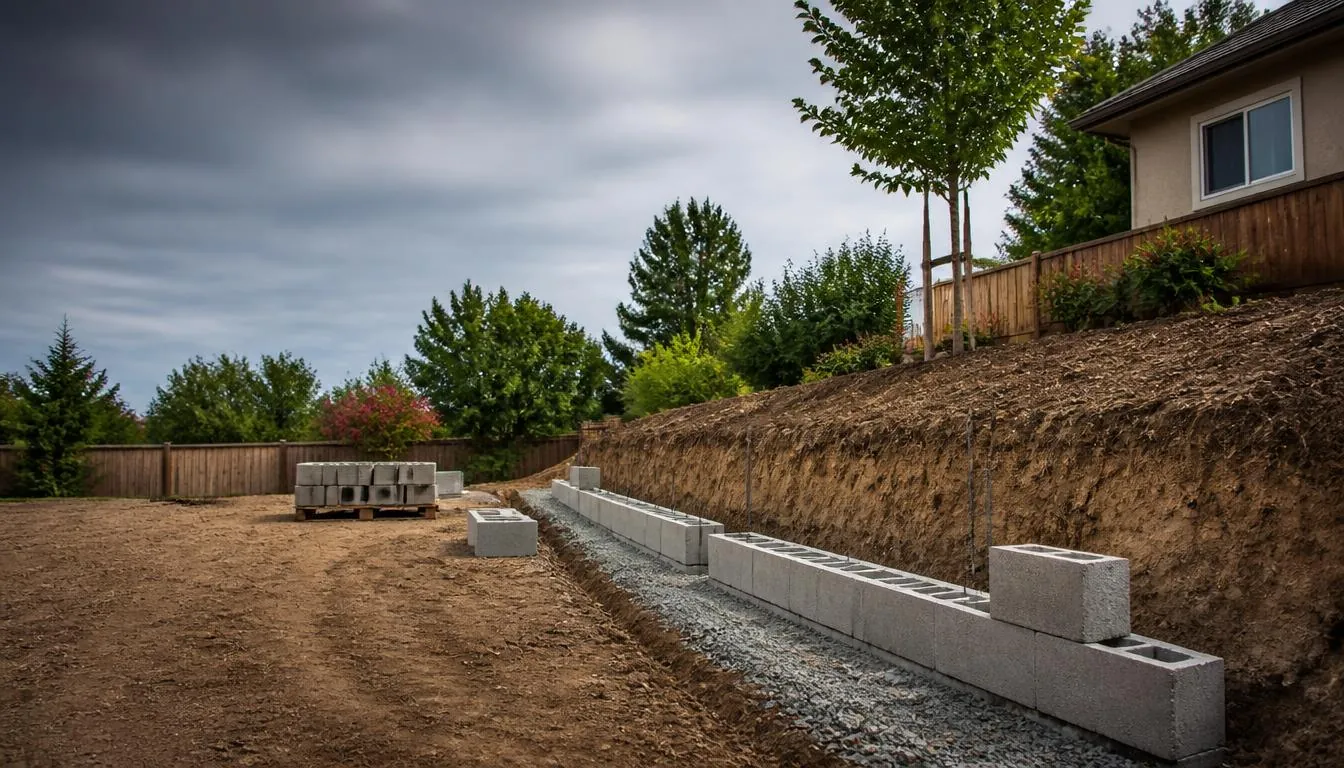
how deep should a retaining wall footing be in Orangevale, CA
The Footing Depth Question Every Orangevale Wall Has to Answer
The footing is the part of a retaining wall nobody sees and everybody depends on. In Orangevale's clay-loam soil, getting the depth right is what keeps a wall standing for decades instead of years.
No obligation. Licensed CA landscape contractor.
A short garden wall in stable soil can sometimes get by with a footing just six to eight inches deep. A taller wall, or any wall built in Orangevale's clay-loam soil, needs to go much deeper, often 18 to 24 inches or more, with the exact number set by wall height, soil type, and drainage. There is no single number that fits every wall. The right depth is the one an engineer or an experienced builder sets after looking at your specific soil and slope.
Why Orangevale's Clay Soil Changes the Math
Clay-loam soil swells when it gets wet and shrinks when it dries out. That movement happens mostly near the surface, in what engineers call the active zone. A shallow footing sits inside that zone and moves with the soil every winter and summer. A footing dug below the active zone sits on soil that stays more stable year round, which is why Orangevale walls typically need more depth than the same wall would need in sandy or gravelly ground.
This is not unique to Orangevale, but it is worth taking seriously here. Much of the ground across Orangevale, Fair Oaks, and Citrus Heights shares the same clay-loam base, so a footing depth that works fine in a sandier part of Sacramento County may not hold up the same way on a typical Orangevale lot.
What a Footing Actually Does
The footing spreads the weight of the wall and the soil behind it across a wider base. Without enough depth and width, that weight concentrates in one spot and the ground underneath slowly gives way. This shows up over time as a leaning wall, a cracked face, or blocks that separate at the seams.
- A footing spreads the wall's weight so the soil underneath does not overload in one spot
- It anchors the wall against sliding forward as it holds back soil and water
- It gives the wall a stable base below frost and moisture swings near the surface
- It works with drainage behind the wall to keep water pressure from building up
How Deep Should a Wall Footing Go in Orangevale Clay?
The starting depth depends on wall height. A wall under two feet tall in stable soil might only need a shallow footing. Once a wall climbs past three or four feet, or sits in clay-loam soil like most of Orangevale has, the footing usually needs to reach well below the active zone described above. California's own geotechnical design guidance for retaining walls confirms that footing depth has to change with the soil type a wall sits on, not stay fixed at one number.
This is also why a proper retaining wall installation in Orangevale always starts with a look at the soil on your specific site, not a generic number pulled from a different yard across town.
Why DIY Walls Fail at the Footing, Not the Face
Most failed retaining walls look fine on day one. The blocks are level, the face is clean, and it holds through a dry summer. The failure shows up months later, once winter rain soaks into the clay behind the wall. A shallow footing sitting inside the active zone starts to move as the soil swells, and the wall above it tips or cracks even though nothing about the visible construction changed.
- A footing dug too shallow moves every time the clay underneath swells or shrinks
- Skipping compacted gravel under the footing leaves it resting on soft, uneven ground
- No footing width beyond the wall's own thickness gives the load nowhere to spread
- A missing drain pipe behind the wall lets water pressure build up right where the footing needs to stay stable
When Orangevale Walls Need an Engineered Footing
Taller walls, walls holding up a slope, and walls near a driveway or structure carry more load than a short garden wall. Sacramento County generally requires an engineered plan once a wall passes a certain height, and that engineering almost always includes a specific footing depth calculated for the site's soil report. A wall in Orangevale clay that skips this step is one of the more common reasons a homeowner ends up paying for a rebuild within a few years.
Signs Your Wall's Footing May Be Too Shallow
A few warning signs point to a footing that was never deep enough for the soil it sits in.
- The wall leans forward more each year, especially after wet winters
- Horizontal cracks appear low on the wall, near where the footing sits
- Blocks or stones separate at the seams even though the wall looked solid at first
- Soil or mulch behind the wall appears to be settling or sinking over time
Catching these signs early is almost always cheaper than waiting for a full wall failure, since a shallow footing rarely fixes itself once the clay underneath starts moving.
What to Ask Before You Hire an Orangevale Wall Builder
A few questions upfront help you tell a builder who plans for clay soil from one who is guessing.
- Ask how they determine footing depth for your specific wall height and soil, not a flat number used on every job
- Ask whether a soil test or geotechnical report is part of the plan for taller walls
- Ask what drainage goes in behind the wall and how it ties into the footing design
- Ask whether the project needs Sacramento County engineering review, and who pulls that permit
A builder who answers these clearly, before ground is broken, is far more likely to hand you a wall that is still standing straight in twenty years.
All Retaining Wall Installation Services in Orangevale
Get a Footing Built for Orangevale's Soil
McGuire Earth Works Inc. digs every footing to match the wall height and the soil underneath it. Call (916) 404-0944 for a free on-site review before you build.
Mon–Fri, 7am–5pm. Licensed CA landscape contractor.