
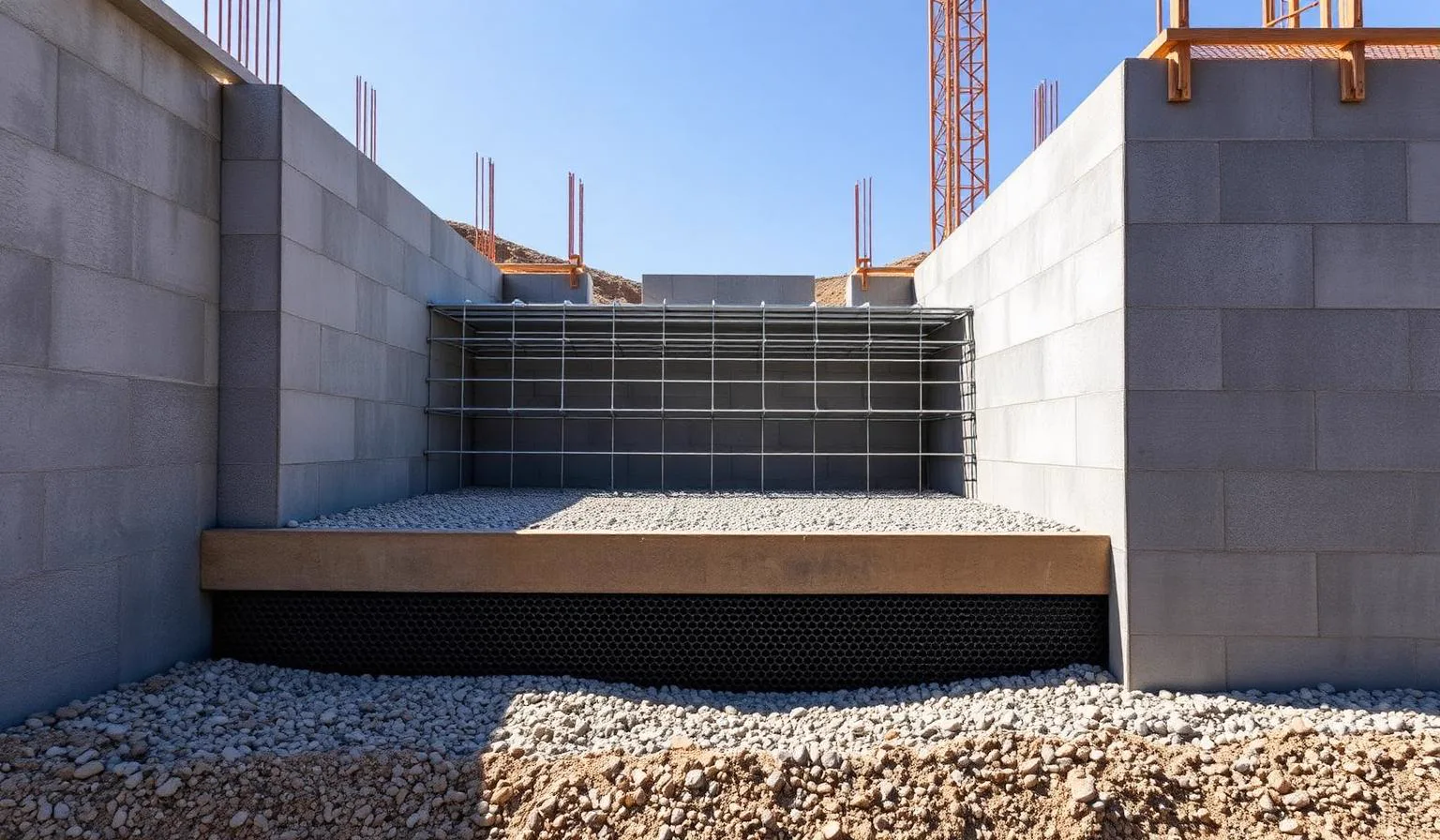
retaining wall geogrid in Orangevale, CA
Does Your Wall Actually Need Geogrid?
Height, slope, and what sits above a wall all decide whether it needs reinforcement. Here's how we size it for Orangevale soil.
No obligation. Licensed CA landscape contractor.
A retaining wall over about four feet, or a shorter wall holding back a slope, a driveway, or a structure, almost always needs geogrid. Geogrid is a mesh layer buried in the soil behind the wall that holds the dirt together and ties it back into the blocks. Without it, a tall wall has nothing but its own weight to resist the soil pushing on it, and in Orangevale's clay-heavy ground that is rarely enough once a wall gets much past waist height.
What Geogrid Actually Does Inside a Retaining Wall
Geogrid is a flat, grid-shaped mesh, usually made from high density polyethylene. It gets laid down in horizontal layers as the wall goes up, with one end locked into the back of the block and the rest running back into the soil. Compacted soil grips the openings in the grid, and the grid resists being pulled forward. The result is a block of soil and mesh that acts almost like one solid mass instead of loose dirt stacked behind a thin wall face.
This matters because soil pushes harder the taller a wall gets, and not in a straight line. A wall twice as tall does not push twice as hard on its base, it pushes much more than that. Geogrid spreads that growing pressure back into a wide, stable soil mass instead of asking the wall face to hold all of it alone.
Gravity Walls vs. Geogrid-Reinforced Walls
Not every wall needs geogrid. A short wall with nothing heavy above it can often stand on its own weight. Here is how the two approaches compare.
| Wall Type | How It Holds Soil Back | Typical Height Range |
|---|---|---|
| Gravity Wall | Weight and friction of the blocks alone | Up to about 3 to 4 feet, with no load above it |
| Geogrid-Reinforced Wall | Mesh layers tied into compacted soil behind the wall | Above about 4 feet, or shorter walls carrying a surcharge |
A surcharge just means extra weight sitting above or behind the wall. A driveway, a patio, a fence, a slope, or a shed all count. Any one of those can push a short wall into needing reinforcement even when the wall itself looks small. Whether the finished face ends up as a concrete block wall, a natural stone wall, or a boulder wall, the geogrid working behind it does the same job either way.
When an Orangevale Retaining Wall Needs Geogrid
Most Orangevale yards that need geogrid have one of three things going on. The wall is taller than about four feet. The wall holds back a slope instead of flat ground. Or something sits above the wall that adds weight, like a driveway, a patio, or another structure.
Orangevale's clay soil adds a fourth reason. Clay holds water and swells when wet, which pushes harder on a wall than drier, sandier soil would. A wall that sits right on the edge of needing geogrid in sandy ground often needs it outright once you account for our clay. We size every wall to our own soil, not to a generic chart built for somewhere else.
Geogrid works together with a wall's footing, not instead of it. A wall can have perfect reinforcement and still fail if the footing underneath is not sized for the soil and the wall's height, which is why we look at both together. See our guide to retaining wall footing depth in Orangevale for how we size that part of the job.
How Geogrid Gets Installed in an Orangevale Wall
- Excavate and compact a level base so the first course of block sits flat and even across the whole run.
- Set the first course of wall block along the base, checked for level in both directions before any backfill goes in.
- Backfill behind the block with compacted soil, in thin layers, up to the height where a geogrid layer is called for.
- Lay the geogrid sheet flat, lock it into the block, and pull it taut back into the compacted soil with no wrinkles.
- Cover the geogrid with more backfill and compact it in thin layers before the next course of block goes on.
- Repeat the layering at each height the engineering calls for until the wall reaches its full height.
Skipping a layer, compacting too little, or leaving the grid loose instead of taut are the most common ways a reinforced wall underperforms. None of those mistakes show up the day the wall is finished. They show up a year or two later, after a few wet winters.
Why Geogrid Matters More in Orangevale's Clay Soil
Clay soil holds onto water long after a storm has passed. That water adds weight and softens the soil, which raises the pressure pushing on a wall well beyond what the same wall would feel in drained, sandy ground. Geogrid gives that heavier, wetter soil something to grip onto instead of just pushing against the back of the wall.
According to a geosynthetics supplier's guide to when geogrid is necessary, geogrid is commonly called for on walls around or above four feet, and surcharge loads such as driveways, slopes, or structures above the wall often call for it on shorter walls too. Weak or clay-heavy soil is one more factor that guide points to, which lines up with what we see across Orangevale.
If you are not sure whether your project needs geogrid, that is exactly the kind of question worth asking before the first block goes down. Our crews design every retaining wall installation in Orangevale around the actual height, load, and soil in front of us, not a one-size-fits-all plan.
All Retaining Wall Installation Services in Orangevale
Build a Wall That Holds for the Long Run
McGuire Earth Works Inc. engineers every wall around its real height, load, and soil. Call (916) 404-0944 for a free estimate, and ask whether your project needs geogrid before you start.
Mon–Fri, 7am–5pm. Licensed CA landscape contractor.