
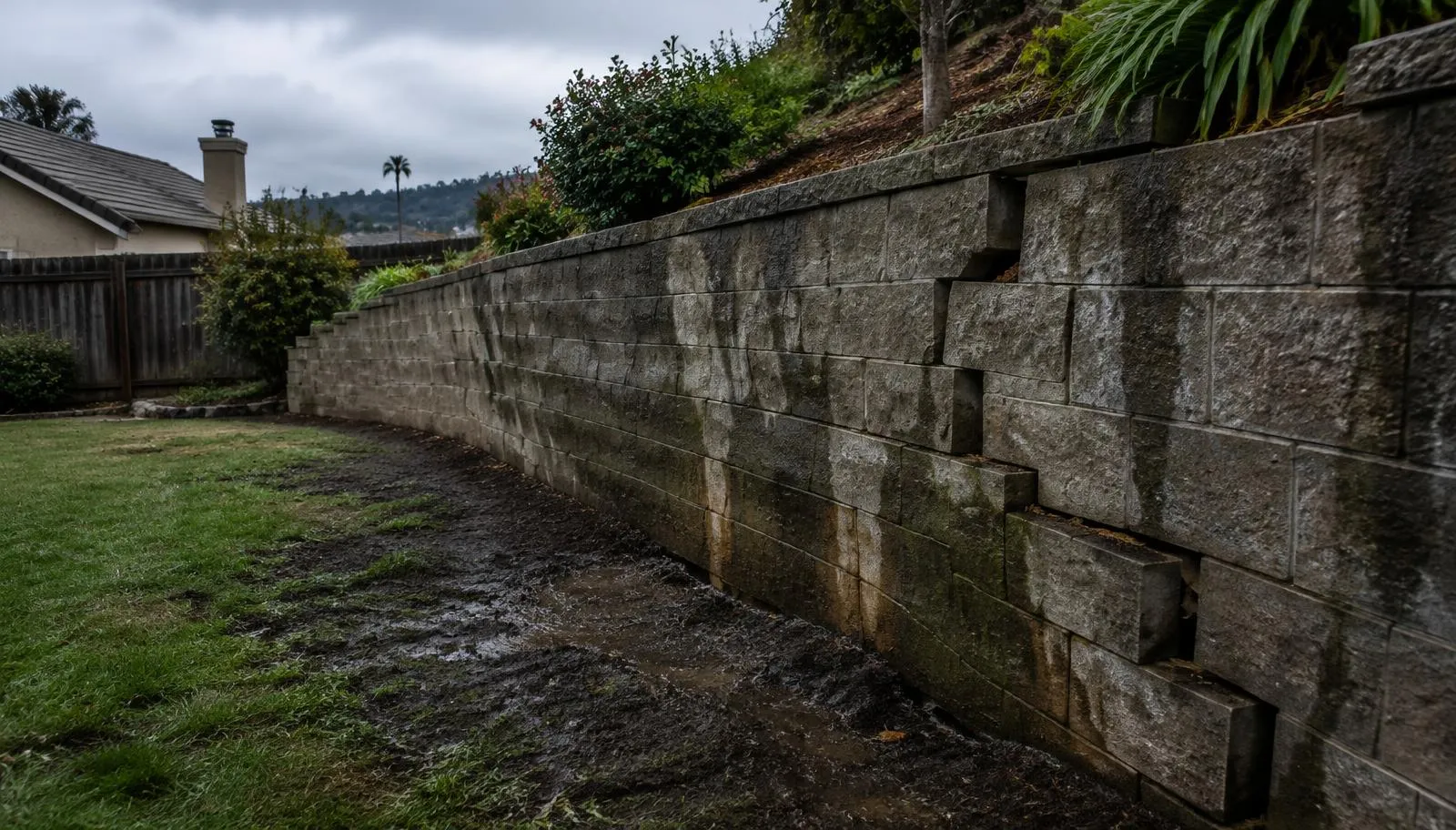
signs of retaining wall failure in Orangevale, CA
Catch a Failing Wall Before It Falls
A retaining wall rarely collapses without warning. It gives off signs first. Here is what to look for in an Orangevale yard.
No obligation. Licensed CA landscape contractor.
Why Retaining Walls Fail
The soil behind a retaining wall pushes outward all the time. It never stops. The wall is built to hold that push back. A well built wall can do this for many years.
The trouble starts when water builds up behind the wall. Wet soil is much heavier than dry soil. Water itself also pushes on the wall. When water cannot drain through or under the wall, the pressure grows far past what the wall was built to hold.
That is why most failures trace back to water, not to the blocks themselves. The blocks are often fine. What failed was the drainage behind them. Knowing this helps you read the signs below. Almost every one of them is a clue about water.
Many retaining walls in Orangevale were built in the 1980s and 1990s. Some of them went in without drain gravel or a drain pipe. Those walls can stand for a long time and then start to show signs all at once.
Bulging or Leaning
A wall that bulges or leans is moving. This is the sign to take most seriously. The good news is that it is easy to check on your own.
Stand at one end of the wall. Look straight down its face, like sighting down a board. A straight wall looks straight. A wall that is moving shows a belly or curve. You can also hold a long, straight board flat against the face. Look for gaps between the board and the blocks.
Check the top of the wall too. If the top sticks out past the bottom, the wall is leaning forward. Any outward curve or lean is worth watching. Take a photo from the same spot each season so you can compare.
Allan Block's wall care guide says to check your wall each spring for bulges or rotation. It also says to have a professional look at any real forward movement and find the cause.
Cracks and Separated Blocks or Joints
Not every crack is a problem. Thin hairline cracks in mortar or concrete block are common. They often come from normal drying and small shifts. Many are only cosmetic.
Some cracks tell a different story. Watch for these:
- A crack that gets wider over a few months
- A stair-step crack that zigzags up through the joints
- Blocks that have pulled apart and no longer sit flush
- Cap stones that have shifted or popped loose
- Gaps that open at the ends where the wall meets a slope
These point to movement underneath. Something below or behind the wall is shifting. A simple trick is to mark both ends of a crack with a pencil and the date. If the crack grows past the marks, the wall is still moving.
Wet Spots, Soggy Ground, and Staining
A retaining wall should let water out. Dry-stacked walls drain through small gaps between the blocks. Other walls drain through weep holes near the base. Either way, water should leave in small, steady amounts.
Watch the wall after a good rain. If water seeps out in sheets across the face, that is a warning. If the ground at the base stays soggy for days after the rain stops, that is another. Both mean the drainage behind the wall is not doing its job.
White or rusty streaks running down the face are also a clue. This is mineral staining. It is often old water doing the same thing slowly over many seasons. Moss or green growth in one strip can mean the same.
Settling and Low Spots Behind the Wall
Walk the ground behind the wall, not just in front of it. Look for places where the soil has sunk or formed a dip. Look for cracks in the soil that run along the length of the wall.
A low spot behind a wall acts like a small pool. Rain collects there instead of running off. That water soaks straight down right behind the blocks. It adds weight and pressure right where the wall is weakest. A dip near the top of a wall is a good reason to have it checked.
Many Orangevale yards also have downspouts, sprinklers, or a sloped lawn that send water toward the top of a wall. Walk the yard during a storm or while the sprinklers run. See where the water goes. If it flows toward the wall and stops there, it is feeding the same problem every time.
Orangevale Clay Makes This Worse
Orangevale sits on clay-loam soil. Clay swells when it gets wet. It shrinks and cracks when it dries out. This happens every year as the rainy season turns into our long, dry summer.
That swelling adds extra push behind a wall. A wall with good drainage can handle it. A wall with poor drainage gets hit twice: once by trapped water and again by swelling clay. A wall with a shallow footing feels this most, because it has less holding it in place. To learn how deep a base should go, read our guide on retaining wall footing depth.
How Long This Takes to Show Up
These signs do not show up overnight. A wall can look fine for years while pressure slowly builds behind it. Then one wet winter can push it over the edge. Once movement starts, it often speeds up.
That is why a yearly check matters, even on a wall that looks fine. Different materials also age at different speeds. Timber rots, and block and stone last longer. For more on how wall materials hold up over time, read our guide on retaining wall lifespan.
If you spot any of these signs, call McGuire Earth Works Inc. at (916) 404-0944 for a free estimate. We will look at the wall and find the cause. Catching these signs early is cheaper and safer than waiting for a collapse.
Frequently Asked Questions
Is a little bit of lean normal on an older wall?
Can a leaning wall be fixed without rebuilding it?
What drainage problem usually causes these signs?
All Retaining Wall Installation Services in Orangevale
Get a Wall Inspection
McGuire Earth Works Inc. builds and repairs retaining walls across Orangevale. Call (916) 404-0944 for a free estimate.
Mon–Fri, 7am–5pm. Licensed CA landscape contractor.